
Fauci and the Fifth
Fauci Must Be Held in Contempt of Congress
Anthony Fauci repeated the following phrase 111 times last Wednesday.
“On the advice of counsel, I respectfully decline to answer based upon my rights under the Fifth Amendment to the Constitution.”
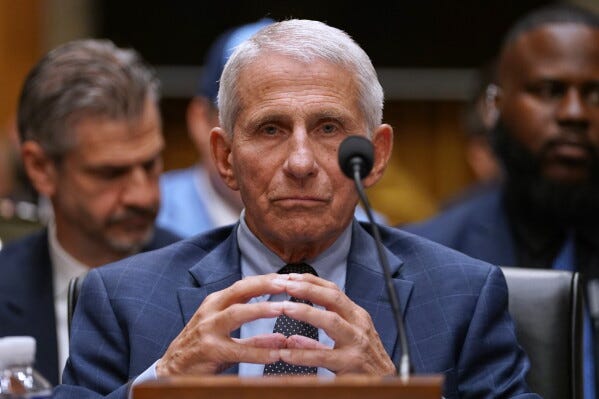
Those twenty-one words were all the former NAID Director and face of the COVID-19 public health response had to say, and he repeated them for every question he faced. When asked whether there was a carpet on the floor in front of him (or what color it was), he pleaded the Fifth. When asked what color tie he was wearing (or what day of the week it was), he pleaded the Fifth. And when asked how he could plead the Fifth despite his presidential pardon, he pleaded the Fifth.
If Fauci could have answered one question last week, it was that one. If Joe Biden’s pardon shields Fauci from criminal liability, his ability to incriminate himself disappears. Without that, the Fifth Amendment has no text to provide him with any protection.
The Fifth Amendment provides that no person “shall be compelled in any criminal case to be a witness against himself.” The key phrase here is against himself. The privilege granted by the Amendment exists precisely to guard individuals from testimony that could be employed to prosecute them criminally. It does not provide a general right to refuse questions that one deems uncomfortable in an attempt to protect their own reputation, or what is left of it.
Chief Justice John Marshall recognized this in United States v. Burr (1807), where the Supreme Court held that the privilege applies when compelled answers create a “real danger” of criminal prosecution. The question has been litigated since. In Brown v. Walker (1896), the Court concluded that where criminal liability has been previously eliminated through immunity, the privilege no longer exists. This was reaffirmed in Kastigar v. United States (1972), which stated that the Fifth Amendment exclusively protects against compelled testimony that could lead to criminal prosecution. The protection granted by the Fifth Amendment has, since the Founding era, operated solely in the context of criminal jeopardy.
The protective nature of a pardon is also well-established. Article II authorizes the president to “grant Reprieves and Pardons for Offenses against the United States,” which the Supreme Court has interpreted broadly. The most notable example was Gerald Ford’s pardon of Richard Nixon prior to any criminal indictment taking place. When ruling in Burdick v. United States (1915), the Court famously noted that the acceptance of a pardon carries an implication of guilt. Woodrow Wilson had granted newspaper editor George Burdick a pardon seeking to have Fifth Amendment protections dropped. Because Burdick refused Wilson’s pardon, he retained his privilege against self-incrimination and therefore invalidated any attempt from the government to compel testimony. Once a pardon is accepted, the government may compel testimony.
Fauci’s posse of lawyers were doubtless fully aware of this history, yet their advice was to fall back on a protection Fauci apparently cannot claim. There are a few possible theories they could offer in support of this tactic, but none hold water.
First, a federal pardon does not provide protection against state prosecutions or future crimes, and a witness could retain the privilege if truthful answers present the danger of criminal liability outside the scope of the pardon itself. Florida Attorney General James Uthmeier already announced an investigation into Fauci. However, the mere possibility of future charges from the state level does not create the “reasonable fear” of prosecution required to invoke the Fifth Amendment. Courts have long held that the privilege applies only when the risk of prosecution is substantial. A general investigation announced amid partisan theater falls far short. Federal officials acting within the scope of their duties enjoy significant protection under the Supremacy Clause. Thus, Uthmeier’s announcement supplies no genuine basis for Fifth Amendment protection in a congressional hearing concerning conduct already covered by the federal pardon.
Next, Fauci’s team could point to the questions surrounding Fauci’s pardon and conclude that a risk of federal prosecution still exists should a court find it unconstitutional. If state prosecutions fail the reasonable, concrete apprehension test, this certainly does. No presidential pardon has ever been successfully challenged in court. Allowing the privilege on the basis of such an attenuated “what if” would gut the requirement of real danger and let any pardoned witness refuse to answer by inventing imaginary future court reversals. Speculative fear of an event that has no realistic prospect of occurring simply does not satisfy the constitutional standard.
Fauci’s supporters argue the hearing was a perjury trap, and that a fear of committing perjury is textbook Fifth Amendment territory. However, legal experts disagree. Former DOJ attorney Abhishek Kambli told Fox News that this objection is baseless. “If it’s just factual questions that he should know the answer on, it’s hard to see how he would walk into a perjury trap if he’s just telling the truth, because perjury also requires that you knowingly made a false statement,” Kambli said. “If he had an incorrect recollection, that was an innocent mistake that typically wouldn’t lead to a perjury charge.” Ultimately, Fauci’s strategy was purely tactical. He could not legally plead the Fifth, so he illegally pleaded it. Aside from kicking one of his lawyers out of the room, Congress has yet to enforce any penalty on him. Unfortunately, they may have weakened their ability to ever hold Fauci accountable.
When testifying before Congress, a witness cannot simply refuse to answer any questions. Generally, the privilege must be asserted on a question-by-question basis. This means that the committee had the legal authority to demand a justification for the specific criminal exposure that was presented by each individual question, calling into question the basis for the privilege itself.
This matters because Congress cannot hold a witness in contempt for invoking the Fifth Amendment alone. Until successfully challenged, the privilege belongs to the witness. A challenge must be initiated by the Committee itself, and if the Committee determines that the pardon removes all legal risk for a specific question, the Chairman can direct the witness to answer. Congress can only proceed with a valid contempt referral if the witness continues to refuse after a directive from the Chair.
In other words, the constitutional issue at hand is not only whether Fauci rightfully invoked the Fifth, it also includes whether the committee sufficiently examined his entitlement to invoke it at all. Prior to dismissing the existence of privilege, Congress should have explored whether there was any genuine remaining risk of federal prosecution. Instead, they accepted blanket invocations of the Fifth Amendment. As it stands, it is not entirely evident that the necessary procedural steps were present.
Fauci’s 111 invocations of the Fifth are an insult to the American people and the Constitution. The constitutional text, the Supreme Court’s precedents, and the settled effect of an accepted presidential pardon all confirm that once pardoned, Fauci lacked Fifth Amendment protection. Nevertheless, Congress let the moment slip by. The result is a dangerous precedent. A witness can recite twenty-one words and walk away untouched, no matter their immunity from incrimination. If accountability for the COVID-19 response means more than mere theater, Congress must hold Anthony Fauci in contempt of Congress.
Andrew Schofield, a native of Long Island, New York, will be entering Hillsdale College this fall with interests in politics, theology, constitutional law, and American political thought. He writes on those topics at First Principles & Last Things. He is also a correspondent for Campus Reform and contributes to the Patriot Perspective, a show affiliated with the Gateway Pundit.


