
The debate over birthright citizenship is back on. Well, sort of.
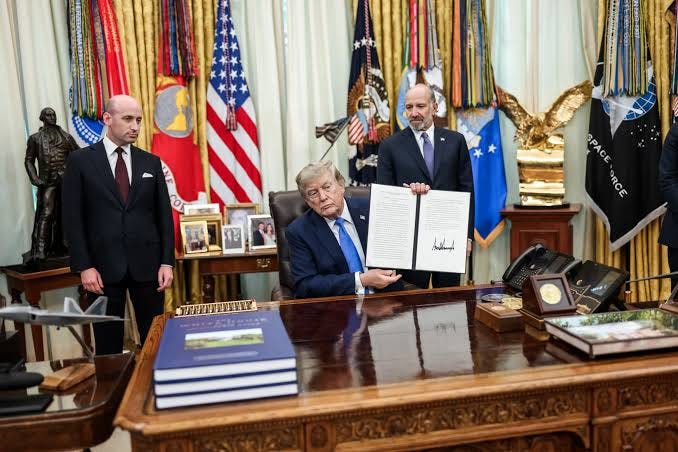
After the Supreme Court struck down President Trump’s executive order seeking to end birthright citizenship for the children of temporary visitors and illegal aliens in Trump v. Barbara, the President signed two new orders that attempt to advance his immigration agenda while within the contours of the Court’s ruling. While both orders are legally tighter and better reasoned than the order invalidated in Barbara, one of them stands on significantly stronger legal ground than the other.
The first order, “Continuing to Protect the Meaning and Value of American Citizenship,” gives Trump’s original order a one-word update after Barbara: “Continuing.” Nonetheless, the legal theory has not changed as much as one word. Similar to the administration’s first attempt, the most consequential provisions are unlikely to survive legal scrutiny. The provisions that survive restate exceptions the Court already recognizes.
The order identifies four categories of people to whom “no executive department or agency shall issue documents recognizing United States citizenship,” provided neither parent is a citizen.
The first category covers the children of at least one parent who is designated as an “alien enemy,” including members of designated Foreign Terrorist Organizations and Specially Designated Global Terrorists. Trump cites this authority under the International Emergency Economic Powers Act. However, the enemy exception in Barbara does not depend on the designation of the parent. It applies to children born in enemy-occupied territory outside of United States control. IEEPA may allow the president to designate and sanction terrorists, but it does not allow him to deny citizenship to their children born in the United States. Therefore, this provision is likely to be struck down.
The second category covers children of a “person who is a foreign government employee.” While parts of this category could be upheld as part of the Court-recognized exceptions, the order takes a broader approach. The traditional exception applies to ambassadors and other diplomats who are granted immunity from United States jurisdiction. Because not all employees of foreign governments are granted this immunity, the order’s broad inclusion of those employees is unlikely to be upheld.
The third category targets birth tourism, “when the parents of a person engage in a commercial transaction to ensure that the person’s mother is in the United States… to give birth.” However, the Court’s reasoning in Barbara makes the motive or intent of the parents irrelevant to the citizenship of the child once the child is born on U.S. soil and subject to its jurisdiction.
The fourth and final category applies to a person born on U.S. territory or territorial waters where “citizenship is not conferred by federal statute.” This provision likely survives because it is consistent with Supreme Court precedent regarding citizenship in the territories. The order cannot deny citizenship where either the Constitution or Congress already confers it. But where citizenship depends on federal statute and no statute provides it, the order does little more than restate existing law.
The second order, “Ending Birth Tourism,” rests on firmer legal ground. The order seeks to end birth tourism by defining the practice as entering the United States “via a nonimmigrant visa for the purpose of giving birth on American soil,” as well as facilitating such an entry. It directs the Secretary of State and the Secretary of Homeland Security to prevent foreign nationals from entering for that purpose through visa denials, revocations, and other immigration-enforcement measures. Importantly, the order limits those actions to the authority the departments already possess under federal law.
The difference between the two orders is not the policy Trump is attempting to achieve, but the legal authority he uses to achieve it.
The first order operates after a child is born by refusing to recognize citizenship, whereas the second operates before the child is born by regulating whether the parent may enter the United States. Once a child is born here and falls within the Citizenship Clause, Barbara requires the government to recognize the child as a citizen. But neither Barbara nor any other Supreme Court precedent holds that a foreign national has a constitutional right to obtain a nonimmigrant visa or enter the country to give birth. Congress has given the president significant authority over the entry of noncitizens into the United States. The Immigration and Nationality Act allows the president to prescribe reasonable limitations governing the entry of aliens. Trump’s birth tourism order delegates that authority to the Secretary of State and Secretary of Homeland Security. Protecting citizenship can look like simply enforcing immigration laws.
The birth tourism order is a far cry from the original order struck down by the Court. Trump is not claiming the power to redefine the Fourteenth Amendment or alter citizenship on any level, but is merely working within his administration’s understanding of the Barbara and the INA. The policy is not entirely new, either. Since 2020, the State Department has treated obtaining citizenship for a child through birth tourism as an impermissible primary purpose for securing a visitor visa. The administration can, therefore, deny visas to applicants whose primary purpose is birth tourism and revoke visas obtained through fraud.
Immigration law, while the most reliable avenue, may not be the only option. The administration can close the front door, but once the mother has crossed it and given birth, not all hope is lost. If the administration wants to go further, they still have Congress as a partner. Suppose a woman enters the United States on a 90-day tourist visa with the full intention of leaving the country before it expires, but plans the trip so she can give birth on American soil. Should Congress pass a law attempting to narrowly regulate examples like this one, it could present the Court with a compelling new exception to consider and an opportunity to address a question Justice Kavanaugh left open in his concurrence.
Under Kavanaugh’s approach, Congress could argue that birth tourism represents a new circumstance and that an exception for birth tourism is “relevantly similar” to the other historical exceptions. A federal statute enacted by Congress is more likely to have a chance at the Court than another executive order. It would still face the constitutional holding adopted by the five-Justice majority, but a narrowly drawn law would give the argument a much stronger chance at the Court than another executive order.
Trump lost in Barbara, but the decision did not foreclose every option for him to implement his immigration agenda, nor did it require his administration to issue visas to birth tourists. It simply means that the administration must explore new options for enforcing immigration laws. A system of checks and balances requires nothing less. Trump’s latest pair of executive orders is part of a healthy constitutional system.
Preston Hill is a junior at UNC-Chapel Hill passionate about law, media, and public service. He serves as president of the Carolina Liberty Foundation and president of UNC's TPUSA chapter. His work has been featured in The Wall Street Journal, Fox News, Politico, Reuters, and more. He is also a case brief writer for the Undergraduate Law Review at Carolina and a contributor to the Carolina Review journal.


