


Following oral argument yesterday in Suncor Energy Inc. v. Commissioners of Boulder County, the Supreme Court has an opportunity to protect tort law from a gross expansion. The eight justices (Alito recused) should take it.
Boulder County, the City of Boulder, and San Miguel County sued Suncor Energy and Exxon in April 2018, alleging that the companies’ use of fossil fuels contributed to climate change and that the companies were fully aware of this risk. According to Boulder, the companies misled the public about the dangers associated with fossil fuels while continuing to promote and sell their products. The plaintiffs sought for the companies to pay their “fair share” – a term often thrown around with minimal definition in such scenarios – of the local costs associated with climate change. The plaintiffs believe the “fair share” the companies owe in this case includes the plaintiffs’ expenses to cover heat, wildfires, flooding, drought, public infrastructure and property, and more. As with most climate change lawsuits, the plaintiffs do not shy away from making high demands.
Perhaps no case better represents the liberal climate crusade than Suncor. Starting in the 1970s, American liberals coined a term that they have desperately raised alarms over ever since. “Global warming”, popularized by geochemist Wallace Broecker, has since expanded to the broader concept of climate change. For decades, liberals and environmentalists have sought a public policy solution to this boogeyman, hopping from “the ozone layer” to “greenhouse gas emissions” to “fracking” as the wind carries them. Even from a conservative perspective, not all attempts to clean up the environment by the means of civic authority are horrible concepts, but the execution of a pro-climate agenda often looks like the facts of the case in Suncor. The difference between liberals and conservatives – and in a way, between textualists and originalists – is whether or how the various levels of government should address climate change.
Suncor was brought in state court, a fact that the companies use as their focal point in their argument. They present two questions to the Court: whether federal law precludes state law claims that are seeking relief for injuries allegedly caused by the effects of interstate and international greenhouse gas emissions on the global climate, and whether the Court has jurisdiction to hear the case. This article will solely examine the first question.
The energy corporations argued yesterday that Boulder’s attempt to recover damages caused by climate change boils down to an extension of its power across state lines. It would be reasonable for the residents of Colorado to sue a corporation if a hydroelectric dam were to burst and cause damages to farms and neighboring towns. This would most naturally be called a state law tort claim. Colorado residents could argue that the dam operator or owners had the duty to operate and maintain the dam in a safe manner, that they breached that duty when the dam failed, and that the failure of the dam directly caused clear and identifiable harm to Colorado farms, towns, public infrastructure, and property. That fact pattern does not line up with Suncor.
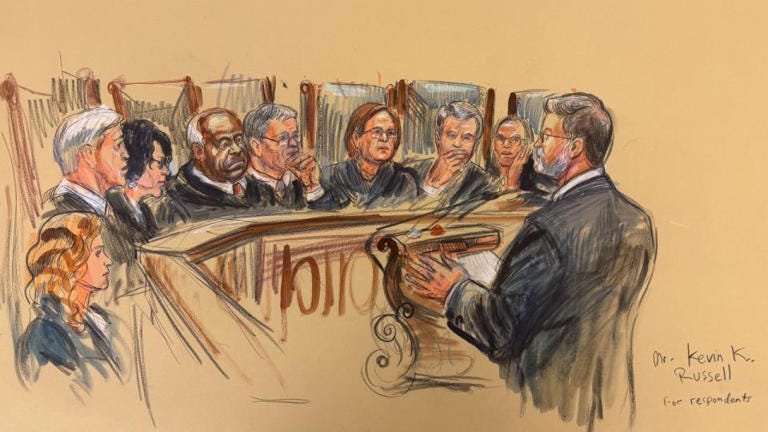
Where the line must be drawn is in examining whether climate change causes a “clear and identifiable harm” to the residents and property owners of Colorado. The Breakthrough Institute’s brief shows why Boulder’s theory overextends itself: “a finding that anthropogenic warming has increased the frequency of wildfires in a region from ten per year to thirteen does not identify which of those thirteen fires was ‘caused’ by warming.” Kannon Shanmugam, the energy companies’ lawyer, opened on that theory and never left it: “Boulder is suing Petitioners under Colorado law on the theory that their global conduct increased the global use of fossil fuels, which led to an increase in global greenhouse-gas emissions, which contributed to global climate change, which resulted in global harms.” There is no traceable, localized injury in the causal chain that must be proved by the plaintiffs.
A harder obstacle for the plaintiffs to clear is the issue of preemption. Justice Kavanaugh said that the Court’s precedents, “as I read them together, make crystal-clear that interstate air and water pollution are matters for federal law unless Congress specifically preserves state law.” He then read the Court’s own warning in American Electric Power Co. v. Connecticut (2011) that an expert agency is “surely better equipped” than “individual district judges issuing ad hoc case-by-case injunctions,” because judges “lack the scientific, economic, and technological resources” for “issues of this order.” On rebuttal, Shanmugam said, “there is no limit under Boulder’s theory on who could be sued.” Boulder could, he said, “tag me with personal jurisdiction when I am in Colorado in two weeks and sue me on a nuisance claim for refilling my car and thereby contributing to global climate change.” About ninety percent of greenhouse-gas emissions occur outside the United States, Shanmugam noted. “Climate change is certainly one of the most pressing issues of the day,” he said, “but we would submit that this is exactly the wrong way to go about resolving it.” For climate change activists, the distinction between state and federal law seems meaningless. Our constitutional system of differentiating the two disagrees.
For these reasons the Court should treat Suncor differently from a regular state law tort action that involves a traceable injury. Boulder likely has a legitimate cause for concern regarding the cost associated with addressing climate emergencies. These do not concern themselves with Suncor or Exxon to the extent that they may be legally liable for a particular portion of the bill. Allowing a Colorado jury to determine a company’s “fair share” regulates conduct far beyond Colorado’s borders. If the demands for accountability have a basis, they must translate to public policy reform, rather than a patchwork of local and state lawsuits.
A. Cooper Haggard is a political science student at Ashland University, with interests in law and public policy. He is in leadership with the Ashland Student Senate and College Republicans and is the president of the Ashland American Conservative Youth Union. He has also interned for the Ashland County Prosecutor’s Office.
