


The beautiful state of Hawaii holds a reputation for its pineapple, coconut trees, and island treasures. Add elephants to that list.
Earlier this month, the Hawaii Supreme Court heard oral argument in Nonhuman Rights Project, Inc. v. City and County of Honolulu. The NhRP, a nonprofit that seeks to change the legal status of animals from property to legal persons, asked the court to treat two Asian elephants at the Honolulu Zoo as persons who may invoke the writ of habeas corpus and move to a sanctuary. The argument was held at Punahou School’s Dillingham Hall and livestreamed by the court.
The NhRP frequently files habeas petitions on behalf of animals in human care, including elephants and chimpanzees. Their novel approach has met skepticism in the courts. In Nonhuman Rights Project, Inc. v. Breheny (2022), the New York Court of Appeals rejected a petition on behalf of Happy, an elephant at the Bronx Zoo. The court held that the writ of habeas corpus does not apply to nonhuman animals. Mari and Vaigai, the two elephants in the Hawaii case, may not fare much better.
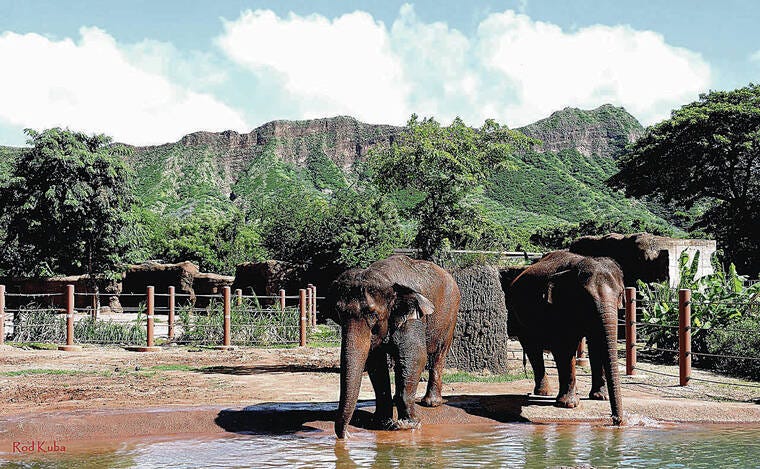
To win the writ, the court must recognize the animals as legal persons. The NhRP leans on cases in which courts have extended some legal rights beyond natural human beings. The Supreme Court, for example, recognized corporate political-speech rights in First National Bank of Boston v. Bellotti (1978), famously upholding them in Citizens United v. FEC (2010). The organization also relies on the 1772 English decision Somerset v. Stewart, in which a court held that an enslaved man, treated as property under the law, could challenge his detention through habeas corpus. Yes, that means NhRP compares slaves to animals. Since the writ is not confined to those already recognized as full legal persons, nothing bars extending it to some animals, NhRP argues.
Before the five-justice Court can reach the constitutional question, it must first decide a problem of statutory interpretation. Hawaii state law authorizes courts to issue writs of habeas corpus “in cases in which persons are unlawfully restrained of their liberty.” The lower courts in the case held that state law supersedes the common-law writ, preventing the elephants from enjoying personhood under the statute. The high court agreed to decide whether the statute displaces the common-law writ and whether that writ applies to Mari and Vaigai.
Jake Davis, a senior attorney for the NhRP, met a skeptical bench at argument.
“Don’t we have Hawaiian judicial precedent and Hawaiian usage that tells us the right to habeas corpus belongs to kānaka [human species]...as distinct from animals?” Chief Justice Vladimir Devens asked. Davis answered that, within the broader common-law tradition, the right to invoke the writ can expand over time.
Justice Todd Eddins also appeared unconvinced by the claim that a ruling could be confined to the two elephants.
“Any time an appellate court addresses any issue, it needs to look at the consequences for the law moving forward. To suggest that this is just Mari and Vaigai and not Kahala dolphins or the octopus at the Waikiki Aquarium, I think you are misplacing what an appellate court does,” Eddins said.
History, Eddins suggested, confines the writ to humans.
“We have Somerset. There is the famous Amistad case and all that,” he said. “Those are human beings and persons, right?”
Justice Sabrina McKenna seemed the most open to the elephants’ claim, doubting that state law supersedes the common-law writ.
“It appears to me that argument probably does not have much weight. It’s pretty clear that the common law writ has not been overruled,” McKenna said. “A statute could not overrule the Constitution.”
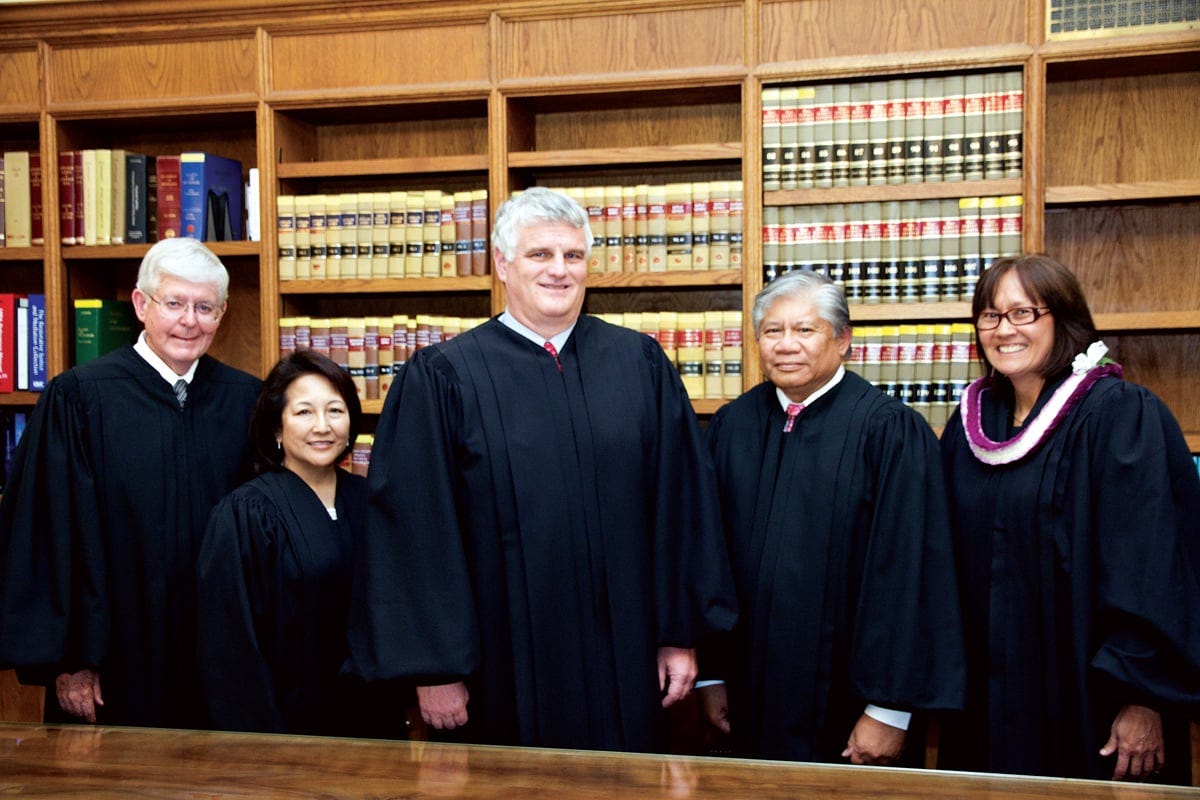
McKenna pushed back against Patricia Sendao, a deputy corporation counsel arguing for Honolulu, who called recognition NhRP’s argument a “monumental shift” best left to the legislature. Judicial evolutions in the law, McKenna said, are not uncommon.
“When this court decided the same-sex marriage case, that was a monumental shift, was it not?” McKenna asked.
She later asked whether the court “would be powerless” if an animal were in desperate condition, if the legislature alone could act. Sendao replied that a suit could be brought under federal or state laws, or that the Association of Zoos and Aquariums could be petitioned.
Justice Lisa Ginoza questioned both sides, but her microphone failed on the livestream, leaving those questions inaudible to remote viewers. Circuit Judge James H. Ashford sat with the court because of a vacancy and did not ask questions.
The NhRP entered the argument as an underdog and left with a few encouraging exchanges, especially from Justice McKenna. Nonetheless, a win remains unlikely. No appellate court has accepted the organization’s theory of animal legal personhood. The Hawaii Supreme Court’s decision to hear the case was a procedural success for the NhRP, but the Court gave no indication that it will expand the writ to zoo animals any time soon.
Blake Fox graduated from Wesleyan University, where he served as opinions editor of The Wesleyan Argus. He interns for SCOTUSblog and serves as an executive litigation assistant for FIRE. He previously taught a college course on the U.S. Supreme Court, has conducted research in animal law, and covers the Supreme Court on TikTok.
